
Our Products
Rayland Medical's consistent self produced and selected products are guaranteed to provide safety for you and your customers
Our Products
Selecting an ultrasound system without considering the probe is a common procurement mistake. The console or software may provide many imaging modes, but the transducer determines the frequency range, field of view, penetration, and access to the anatomy being examined.
The three most common probe formats are linear, convex/curvilinear, and phased array. Each serves a different range of examinations.
For handheld ultrasound procurement, the important question is whether one probe—or one dual-purpose device—can cover the departments expected to use it.
A linear probe has a flat footprint and produces a rectangular image.
Its relatively high operating frequency gives strong resolution close to the skin but limits penetration into deeper anatomy.
ACEP identifies linear probes as particularly useful for vascular ultrasound, procedural guidance, and superficial soft-tissue examinations.
Typical applications include:
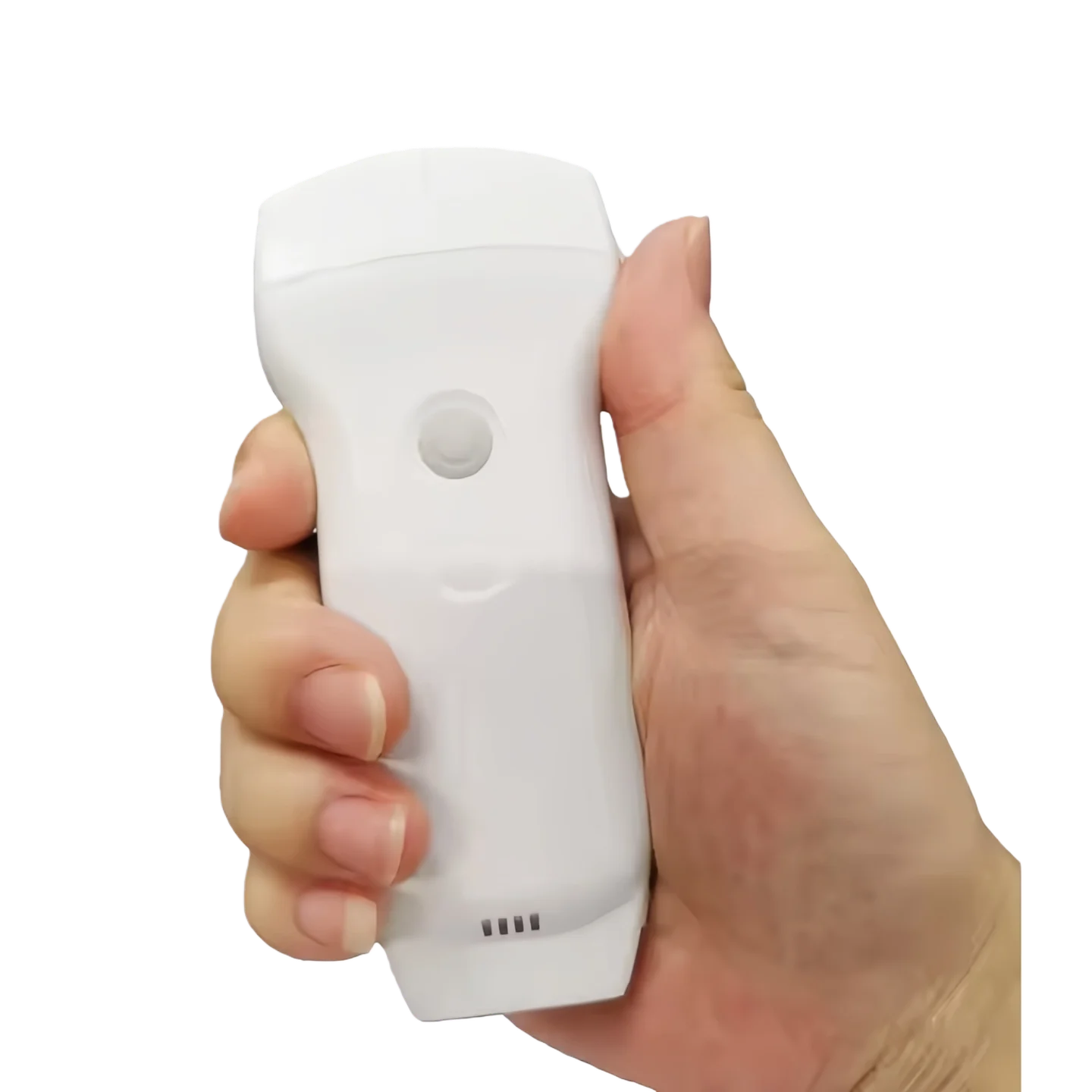
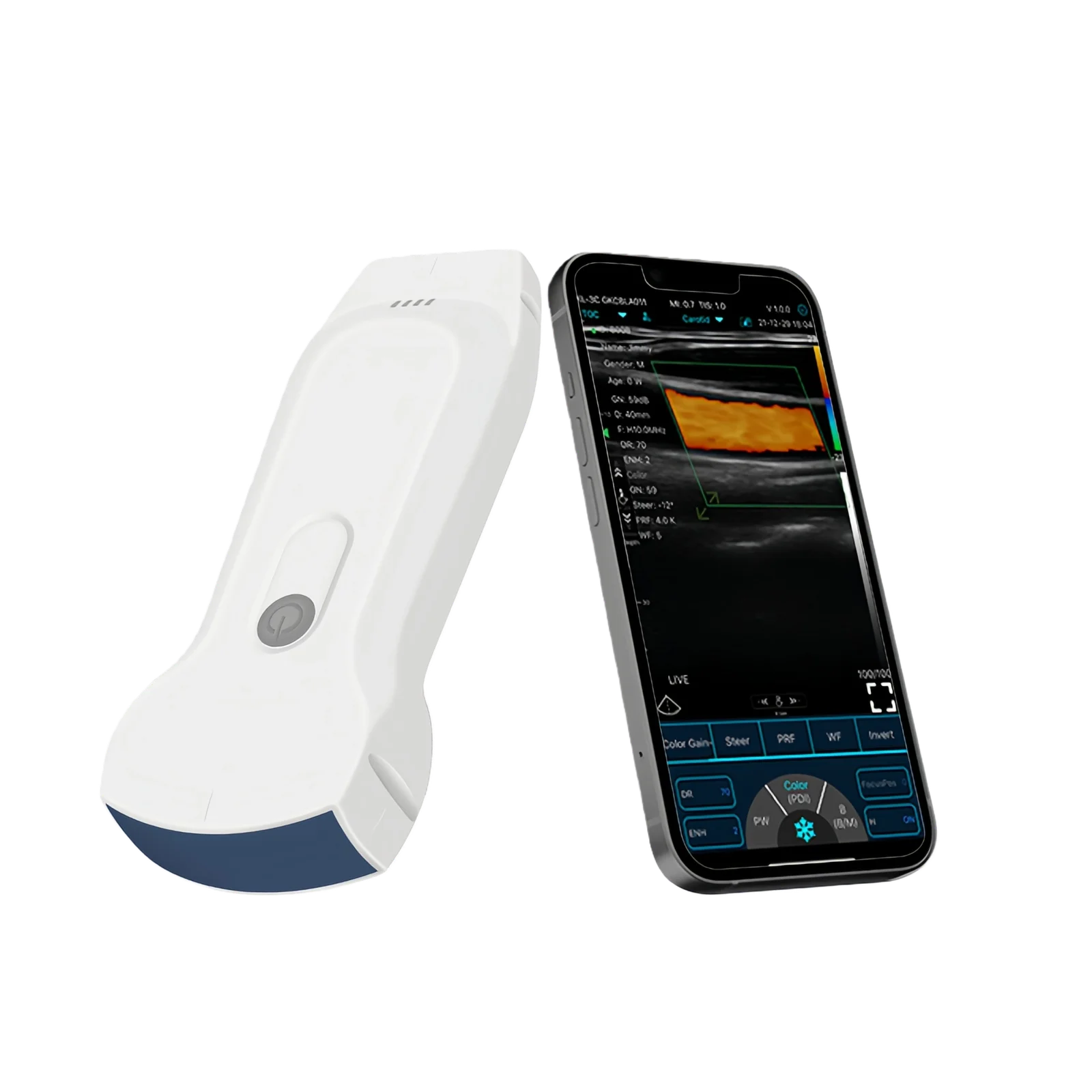
Rayland's handheld linear array operates at 7.5/10 MHz and includes presets for thyroid, carotid, small parts, breast, pediatrics, MSK, vascular, nerve, and vessel-flow applications.
For anesthesia, emergency medicine, and vascular-access teams, the linear probe may be the most frequently used side of a handheld scanner.
A convex or curvilinear probe has a curved footprint and produces a widening field of view.
Its lower frequency allows greater penetration, making it a standard choice for abdominal and pelvic imaging.
Clinical ultrasound references commonly recommend curvilinear probes around 2–5 MHz for deeper structures such as the kidney and abdomen.
Typical examinations include:
Rayland's convex side supports lower-frequency operation and presets including abdomen, urology, gynecology, kidney, obstetrics, lung, and cardiac assessment.
For general POCUS, a convex probe provides much of the deep-imaging coverage required in emergency and outpatient settings.
A phased-array probe typically has a small footprint and low operating frequency.
Its major advantage is the ability to scan through narrow spaces such as between the ribs, making it particularly useful for cardiac ultrasound.
Common applications include:
If comprehensive cardiac imaging is a major purchasing requirement, a dedicated phased-array probe may be preferable.
Some multi-purpose handheld devices instead use hardware and software presets to extend one probe across several applications. These should be evaluated according to the actual cardiac views required rather than simply whether “cardiac” appears in the application list.
High frequency improves detail but sacrifices depth.
Low frequency improves penetration but sacrifices fine resolution.
This explains why a 10 MHz linear probe is useful for a vessel only a few centimeters below the skin but is not the best option for visualizing an adult kidney deep in the abdomen.
Likewise, a 3 MHz convex probe can penetrate deeply but will generally provide less detailed near-field imaging of a superficial nerve than a high-frequency linear probe.
Procurement therefore needs to match probe frequency to target depth.
For vascular access, the linear probe is generally the preferred choice.
Its high frequency provides detailed imaging of superficial vessels and the rectangular field of view works well for needle guidance.
A small footprint can also be useful when working around difficult anatomical areas.
For a hospital purchasing handheld ultrasound primarily for anesthesia, emergency vascular access, PICC placement, or other guided procedures, linear image quality should be evaluated carefully.
For transabdominal examinations, the convex probe is usually the practical choice.
Its wide field and deeper penetration support abdominal organs and obstetric assessment.
For specialized gynecological or early-pregnancy examinations requiring an endocavitary transducer, however, a general-purpose handheld convex probe may not replace a dedicated endocavitary probe.
This should be confirmed before a system is promoted as an all-in-one obstetric and gynecological solution.
A phased array is traditionally preferred for cardiac imaging because its small footprint fits between ribs.
Rayland's current dual-probe handheld model includes a cardiac preset on its convex side, with listed cardiac frequency of 2.5/5 MHz.
This may provide useful basic cardiac POCUS functionality, but procurement teams requiring comprehensive echocardiography should compare it directly with a dedicated phased-array system.
A “cardiac preset” and a “dedicated cardiac transducer” are not automatically equivalent.
Handheld systems increasingly combine several applications into fewer physical probes.
ACEP has noted the growth of 3-in-1 handheld platforms capable of providing linear, curvilinear, and phased-array-style functionality within one device.
The advantage is obvious for mobile use:
The trade-off is that a multi-purpose device should still be evaluated against dedicated probes for the most demanding applications.
A simple procurement guide is:
Emergency / General POCUS: Convex + Linear, with cardiac functionality where needed
Anesthesia: Linear + Cardiac capability
Vascular: Linear
MSK: High-frequency Linear
Abdominal / Urology: Convex
Basic Obstetrics: Convex
Cardiology: Dedicated Phased Array preferred for more comprehensive work
Rayland Medical's handheld ultrasound combines convex and linear arrays in one 120 g device, supporting a broad range of examination presets without requiring users to carry two separate transducers.
Before ordering, list the five or ten examinations the device will perform most often. That usually reveals the correct probe configuration much more clearly than comparing the total number of advertised presets.