
Our Products
Rayland Medical's consistent self produced and selected products are guaranteed to provide safety for you and your customers
Our Products
Handheld ultrasound has moved far beyond simple emergency screening. Current devices can provide B-mode imaging, color Doppler, pulsed-wave Doppler, measurements, multiple examination presets, and image storage through a smartphone or tablet. This naturally raises a procurement question: can a handheld ultrasound replace a traditional cart-based system?
For some point-of-care applications, the answer can be yes. For a hospital imaging department requiring advanced diagnostic examinations across many specialties, the answer is usually no.
The better purchasing decision is to determine which examinations genuinely require a full cart-based platform and which can be performed efficiently with a handheld device.
Handheld ultrasound is particularly useful when the clinical question is focused and the examination is performed at the bedside.
Typical applications include:
A randomized clinical trial comparing handheld and cart-based ultrasound for cardiac, lung, renal, aortic, and biliary POCUS found similar overall diagnostic accuracy between the two formats. However, the cart-based system produced better overall image quality.
This distinction is important: adequate diagnostic performance for a defined POCUS task does not mean the two systems have identical capabilities.
The main advantage is accessibility.
A cart-based system usually has to be moved between rooms or shared by several departments. A handheld scanner can remain with an emergency physician, anesthesiologist, ward team, ambulance crew, or outpatient clinic.
This makes handheld ultrasound useful where the main procurement objective is to increase the number of locations that have immediate ultrasound access.
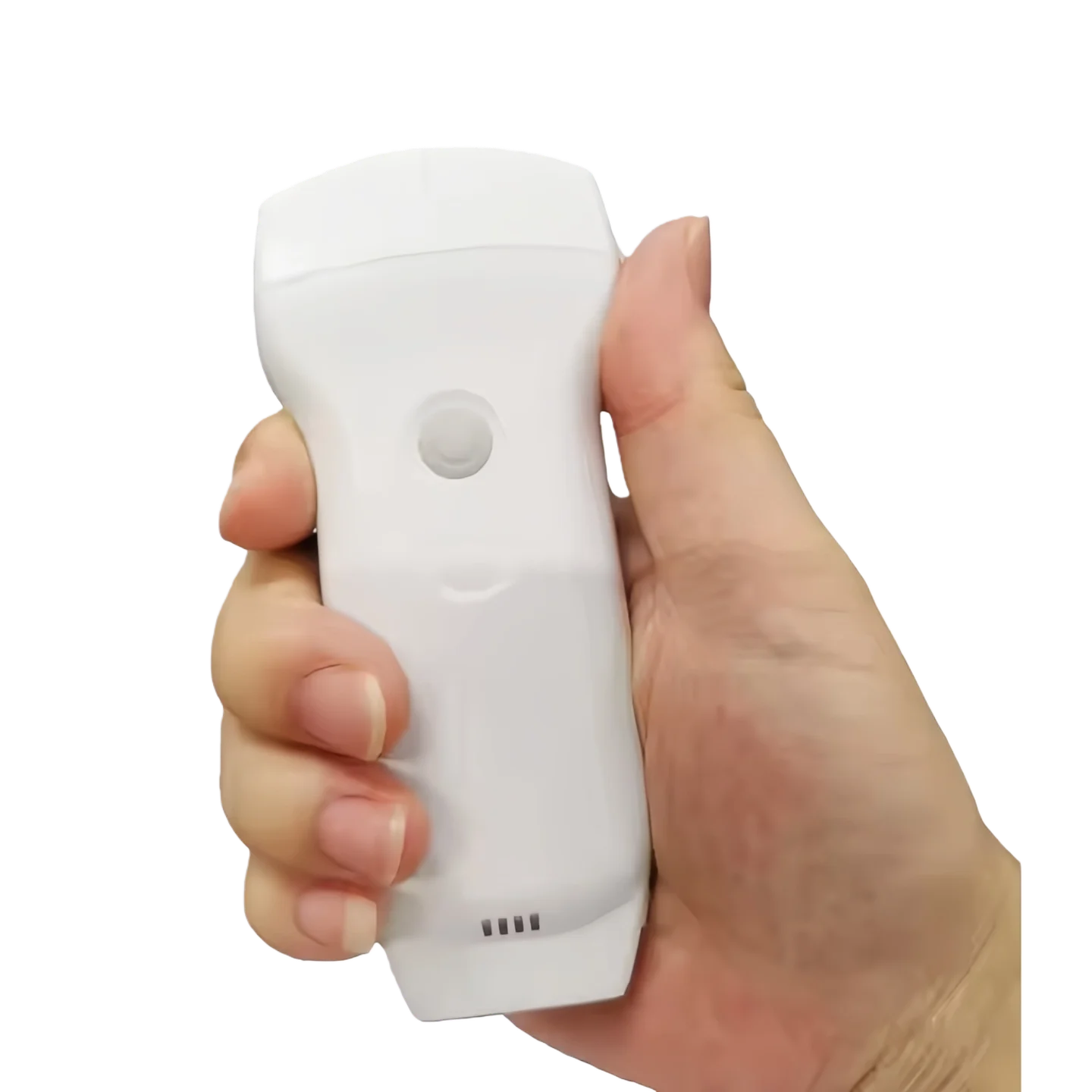
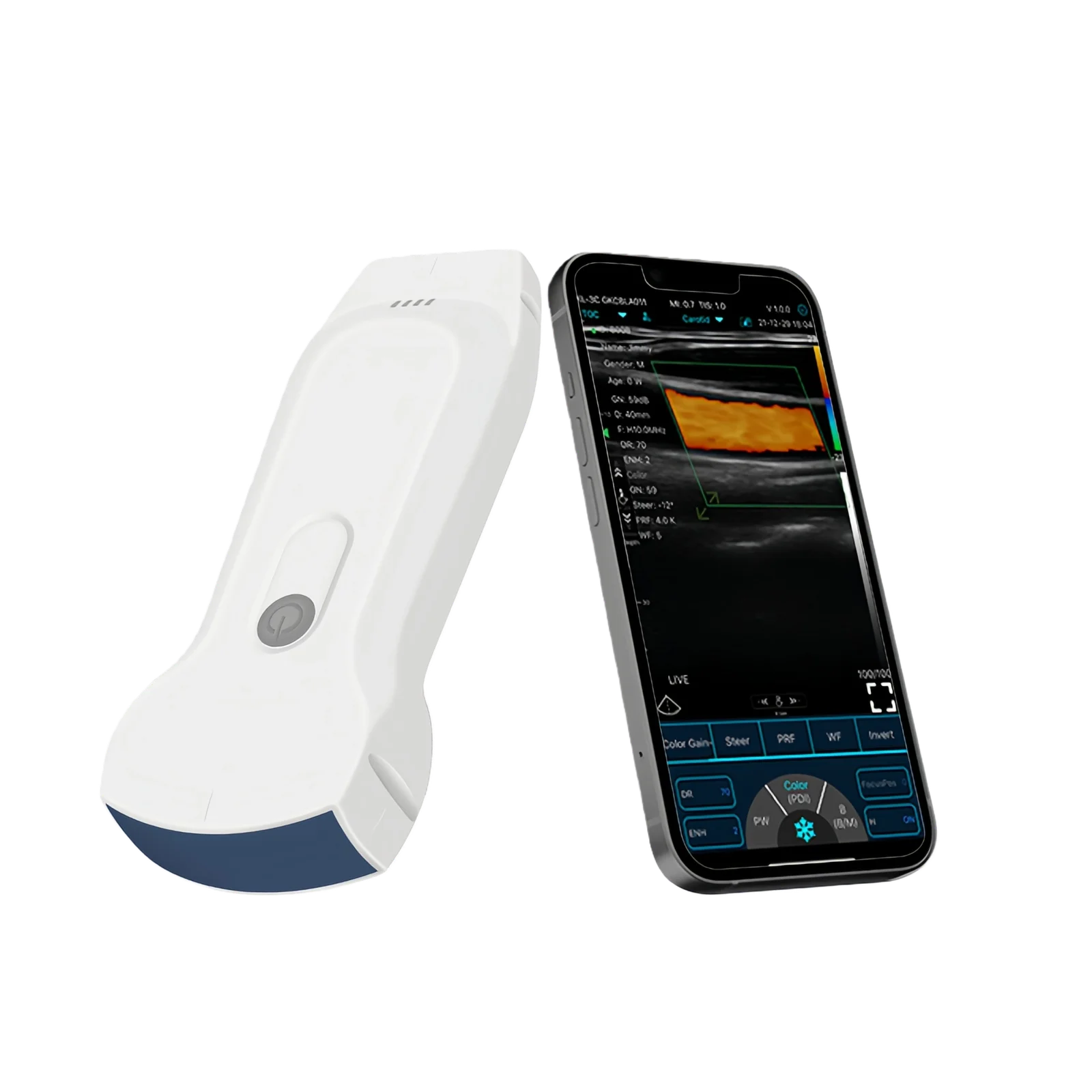
Rayland Medical's handheld system weighs approximately 120 g and connects through WiFi or USB to iOS, Android, and Windows devices. Its dual-sided probe combines convex and linear scanning functions and includes presets covering abdominal, urological, gynecological, obstetric, cardiac, vascular, thyroid, breast, MSK, lung, nerve, and other examinations.
For these settings, portability can be more valuable than having the highest available imaging specification.
A full cart-based ultrasound generally provides more room for advanced hardware, multiple dedicated probes, larger displays, more sophisticated image-processing functions, and a wider range of Doppler and specialty applications.
This becomes important for:
Research comparing portable and conventional systems in musculoskeletal imaging found that the devices agreed or differed without clinically relevant consequences in most cases, but the handheld system had limitations including lower sensitivity of color Doppler and difficulty identifying some small findings.
Therefore, replacing a cart-based unit simply because a handheld scanner is less expensive can create capability gaps.
Handheld ultrasound often depends on a smartphone or tablet for display.
This provides flexibility but also means image review is influenced by:
A larger cart-based monitor can be easier for prolonged scanning, complex measurements, teaching, or simultaneous review by several clinicians.
For quick bedside decisions, however, a tablet or smartphone may be sufficient.
The correct comparison should therefore consider the actual examination workflow, not simply the resolution listed in a technical specification.
Traditional systems can accept several dedicated transducers.
A department may use separate:
Handheld devices solve this differently. Some use several interchangeable probes, while others combine multiple scanning formats in one device.
Rayland's current dual-probe handheld scanner combines convex and linear arrays, with the convex side also providing a cardiac preset. The convex side operates at listed frequencies including 2.5/5 MHz and 3.2/5 MHz, while the linear side provides 7.5/10 MHz.
This creates broad point-of-care coverage, but a procurement team should still confirm whether dedicated specialty probes are required for its clinical workload.
Do not compare systems only by whether they both produce an ultrasound image.
Check the required modes.
Rayland's handheld model currently supports:
B, B/M, Color, PW, PDI, and B+Color+PW, together with measurements for dimensions, obstetrics, cardiac parameters, velocity, and vessel flow.
If the existing cart-based system is primarily being used for these basic or intermediate applications, a handheld alternative may cover a substantial part of its workload.
If the department depends on advanced spectral Doppler, continuous-wave Doppler, elastography, 3D/4D imaging, specialized cardiac packages, or other advanced functions, the comparison changes.
A cart system is normally designed for extended hospital operation.
Handheld units depend more heavily on battery life and connected devices.
Rayland's scanner lists approximately three hours of working time, more than five hours standby time, and USB or wireless charging.
For a clinic performing occasional examinations, this may be more than sufficient.
For a busy department performing continuous scanning throughout a shift, procurement should consider:
Portability solves one workflow problem but may introduce another if charging and device management are not planned.
A device may be clinically useful but difficult to integrate into the hospital if images cannot be stored correctly.
Rayland's handheld platform supports JPG, AVI, MP4, and DICOM image formats.
For institutional purchasing, confirm whether the required DICOM or archive workflow matches the hospital's information systems.
Image storage, patient identification, cybersecurity, and device-management policies can be as important as probe performance when several handheld units are deployed across departments.
A practical procurement model is:
Handheld ultrasound as primary equipment where examinations are focused, mobility is important, and advanced imaging is rarely required.
Handheld ultrasound as supplementary equipment where a hospital already has cart-based systems but needs bedside access in emergency, ICU, anesthesia, wards, ambulances, or outpatient clinics.
Cart-based ultrasound as primary equipment where comprehensive diagnostic imaging and advanced specialty functions are required.
Rayland Medical supplies a dual-probe handheld ultrasound designed for portable clinical use, with wireless and USB connectivity, multiple Doppler modes, broad examination presets, DICOM support, and mobile-device compatibility.
The most useful procurement question is therefore not whether handheld ultrasound can replace every cart system. It is how much of the current examination workload actually requires a cart-based system. Where most scans are focused POCUS examinations, handheld devices can reduce dependence on centralized equipment considerably.