
Our Products
Rayland Medical's consistent self produced and selected products are guaranteed to provide safety for you and your customers
Our Products
Peripheral IV access can be much more difficult in children than in adults. Small vessel diameter, limited visible veins, movement, anxiety, subcutaneous tissue, previous cannulation, and dehydration can all make a routine puncture more challenging.
For pediatric departments, repeated failed attempts are not only inconvenient. They increase procedure time, consume additional catheters and staff resources, and create additional discomfort for the child.
Near-infrared vein finders are designed to make superficial veins easier to visualize before the needle is inserted. Their greatest value is therefore not replacing clinical technique, but providing additional information when visual inspection and palpation are insufficient.
A child's peripheral veins are smaller and can be difficult to see through the skin.
The challenge increases in patients with:
Rayland Medical specifically positions its Vein Finder PRO 500/600 for difficult venous access cases including infants and children, obesity, swelling, chemotherapy patients, poor vascular elasticity, emergency care, and reduced blood volume.
These are precisely the cases where additional visualization can be more useful than deploying the device indiscriminately for every easy venipuncture.
A clinician normally selects a peripheral vein using inspection and palpation.
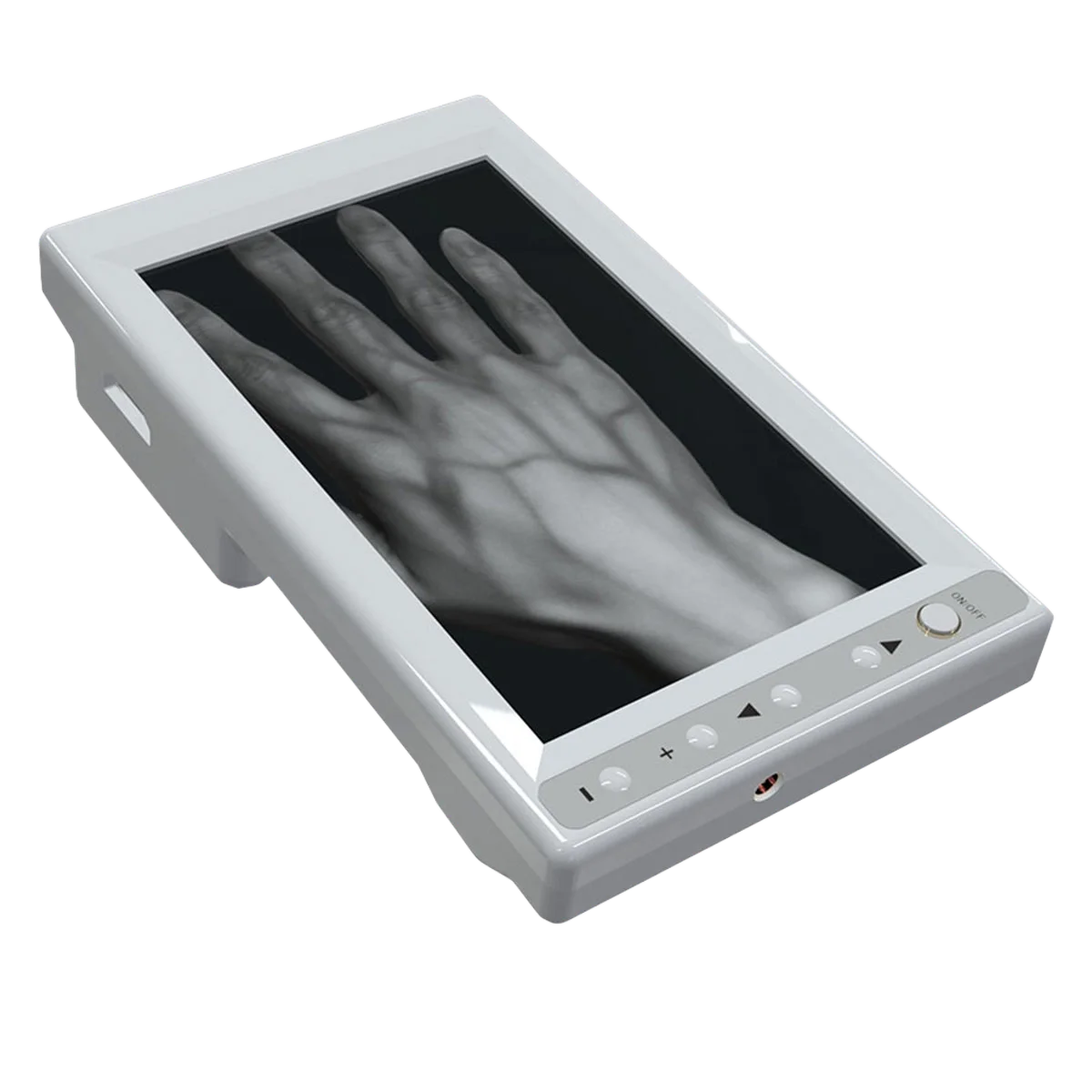
Near-infrared visualization adds another layer of information by showing a projected map of superficial venous structures.
Instead of relying entirely on what can be seen with the naked eye, staff can compare several possible puncture sites before inserting the needle.
This may help identify:
However, the image should support—not replace—palpation and clinical assessment.
A vein that appears clearly on the skin projection is not automatically the best vessel for cannulation.
The clinical evidence is encouraging, but it is not uniform.
A 2022 systematic review and meta-analysis involving seven randomized trials and 1,068 pediatric patients found that near-infrared-assisted peripheral IV cannulation was associated with higher first-attempt success than conventional techniques.
A more recent network meta-analysis examining technology-assisted pediatric DVA found that ultrasound ranked highest, followed by NIR visualization, although the authors rated confidence in the ranking as very low.
Individual trials have produced less positive results. One pragmatic pediatric randomized trial did not find better first-attempt success with NIR imaging, and another trial involving children already known to be difficult to cannulate found no statistically significant improvement.
The procurement implication is important:
a vein finder should not be purchased on the promise that it will eliminate failed sticks.
Its value depends on patient selection, device image quality, staff training, and how the visualization is incorporated into venipuncture practice.
For pediatric use, the vascular image needs to remain usable while the child moves and while the operator changes position.
Rayland's PRO 500/600 uses near-infrared light in the 850–940 nm range and provides real-time vein visualization at a listed working distance of approximately 20–25 cm. The PRO 500 provides 10 display colors, while the PRO 600 provides 16 colors, digital color blending, and deep-neural-network computation.
A non-contact projection system can also allow staff to visualize the area without placing the device directly on the puncture site.
For pediatric wards, a stand or mobile support can be useful when the operator needs both hands free.
Different skin tones, room lighting, and anatomical areas can change how easily the projected vessel pattern is recognized.
Multiple display colors and inverted-image modes allow clinicians to choose the presentation that gives the clearest visual contrast for a particular patient.
Rayland's current vein finder platform provides red, yellow, white, green, inverse, and other display options depending on model.
When evaluating samples, hospitals should test these modes on actual pediatric patients with different skin tones rather than choosing a device according to the number of available colors alone.
An infrared vein finder mainly visualizes superficial vascular patterns.
It does not provide the same information as ultrasound.
NIR visualization generally cannot directly confirm:
When access is very difficult or the target vessel is deep, ultrasound guidance may therefore be more appropriate.
The two technologies should be viewed as different levels of vascular-access support rather than direct substitutes.
Instead of placing one vein finder in every room immediately, hospitals can first identify the areas with the highest DVA burden.
Common starting points include:
Pediatric Emergency Department
Frequent urgent IV access with variable patient condition.
Pediatric Oncology
Repeated previous venous access may make subsequent puncture more difficult.
Infusion Center
High procedure volume makes reductions in repeated searches and failed attempts operationally valuable.
Pediatric Ward
Useful when standard inspection and palpation do not identify a satisfactory vessel.
A mobile floor stand can allow one unit to serve several treatment spaces, while handheld operation may be preferable for bedside or emergency use.
A pediatric vein finder should be tested for actual clinical usability rather than just image brightness.
Review:
Rayland's PRO platform lists a three-hour battery working time and rechargeable/replacement lithium battery, supporting mobile use across departments.